
Robot vacuum vs cordless vacuum: which suits your home?
A robot handles frequent floor maintenance; a cordless stick gives you control over stairs, furniture and concentrated dirt. The right choice depends more on your floor plan and cleaning habits than headline suction claims.
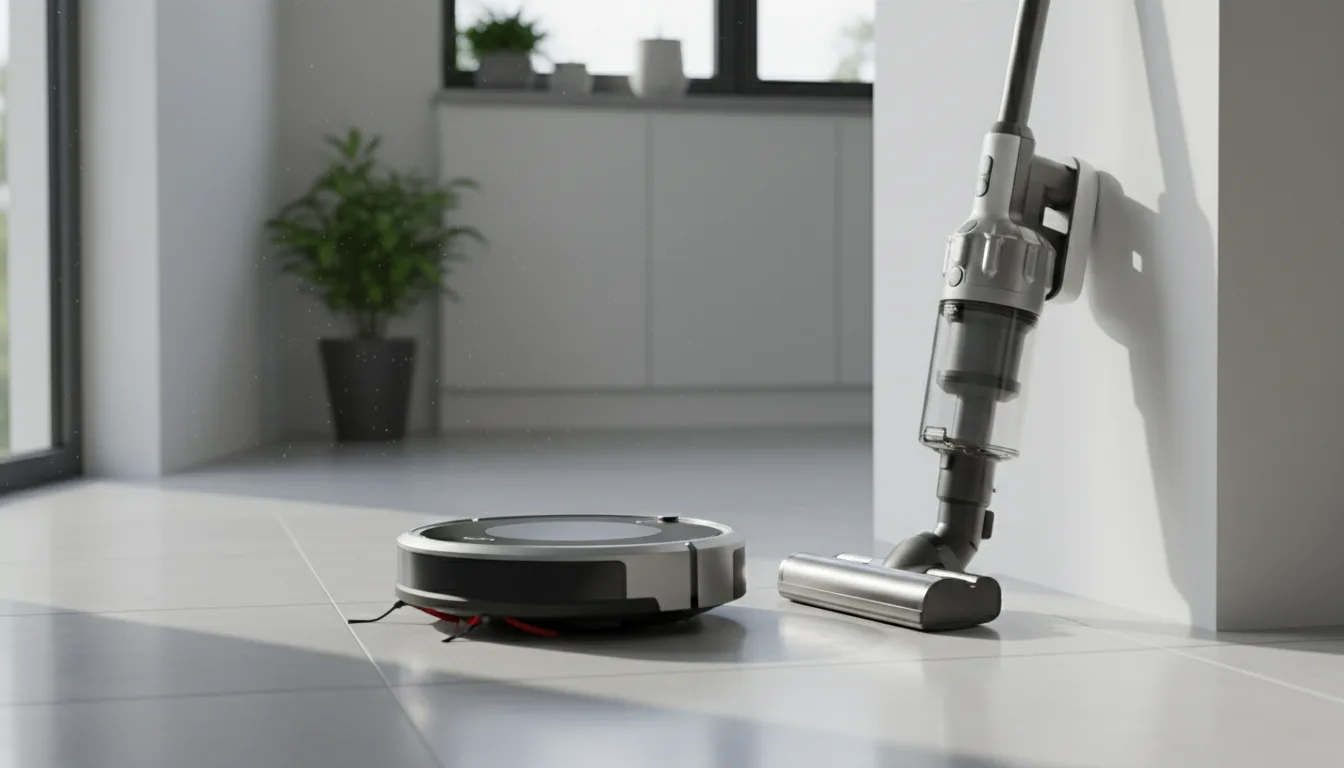
Robots and cordless sticks solve different jobs. A robot is a maintenance appliance: it makes frequent passes over accessible floors. A cordless is a tool you direct, so it reaches stairs, skirting, sofas and sudden spills.
Do not compare quoted suction numbers across brands unless the units and test method match. Floor-head design, navigation, filtration, battery behaviour and parts support matter just as much.
Quick verdict
Choose a robot if most of your home is on one level and you will prepare the floor for scheduled cleaning. Choose a cordless if you have stairs, rugs, furniture and spot-cleaning jobs. If budget allows, they complement rather than replace each other.
At a glance
| Robot vacuum | Cordless vacuum | |
|---|---|---|
| Main job | Frequent floor maintenance | Directed whole-home and spot cleaning |
| Stairs and upholstery | Cannot clean them | Suitable with the right tool |
| Effort | Low during a run; floor prep still needed | Manual for every clean |
| Obstacles | Cables, thresholds and clutter can interrupt it | User works around them |
| Storage | Permanent floor dock | Wall or freestanding charger |
What each option is
Robot vacuum. A battery-powered floor cleaner that navigates automatically, normally maps rooms through an app and returns to a charging dock. Some models mop or empty their own bin.
Cordless vacuum. A rechargeable stick and handheld vacuum. You guide the floor head and change tools for crevices, upholstery or mattresses.
Category by category
Real coverage
A robot is strongest on open hard floors. It cannot climb stairs and may miss tight corners or areas blocked by furniture. A cordless reaches more surfaces but only where you take it.
Daily life
A robot works best when cables, socks and small toys are cleared. A cordless starts immediately for rice, crumbs or car cleaning but requires your time.
Maintenance
Both need bins and filters cleaned. Robots add side brushes, sensors, wheels and sometimes mop pads; self-empty docks add bags and take more space.
Battery claims
Published maximum runtime normally reflects a lower-power mode. Carpet, motorised heads and maximum suction shorten cordless runtime; complex maps and repeated passes affect robots.
Privacy and connectivity
App-connected robots may store maps and depend on cloud services. Review account security, update support and deletion controls. A basic cordless can work with no account or network.
Who each suits
Cost & availability in Malaysia
The official Dyson Malaysia page listed V12 variants from roughly RM1,999 to RM2,999 when checked, illustrating the premium end of cordless models. Robot prices vary widely with navigation, mopping and self-empty features; compare the cost of batteries, filters, brushes, pads and dock bags before purchase.
Our recommendation
For one purchase, choose the cordless unless your biggest problem is maintaining a large, single-level floor every day. A robot saves routine effort; it does not remove the need to clean stairs, edges and furniture.
Related guides

Air fryers worth considering in Malaysia
Five current models for different household sizes, from a simple 4.2L basket to dual-zone and steam models. We compare official capacity, functions, footprint, price and the trade-offs that matter in a Malaysian kitchen.
How much electricity does an air conditioner use in Malaysia?
Estimate air-conditioner consumption from rated input, runtime and compressor behaviour, then read the result against Malaysia’s current tariff structure. A worked example shows why nameplate wattage is a ceiling, not an exact monthly bill.
How to choose an electric oven for a Malaysian kitchen
A practical guide to oven type, usable capacity, electrical safety, installation space and the controls that matter more than a long preset list.
How to choose refrigerator size and read the energy label
Work from usable capacity, doorway measurements and the current Malaysian energy label before comparing door layouts or smart features.